You filter for a job title, company size, and country. LinkedIn gives you thousands of people who match your ideal customer profile (ICP) on paper and have never heard of you. Then you spend the week rewriting the connection note.
Rewriting the note misses the main weakness. A filtered search tells you who somebody is. It tells you nothing about whether they are thinking about the problem you solve, which affects whether they accept and reply.
The short version
List quality sets the ceiling for LinkedIn lead generation.
The platform also holds audiences that carry evidence of interest. Start with those signals before you fall back to a title filter. A stronger source can improve the funnel without another round of message edits.
Where B2B leads on LinkedIn come from
The six practical ways to build an outreach audience on LinkedIn carry different signals.
| Source | What it tells you | What you can open with |
|---|---|---|
| Filtered search by title, size, geography | Who somebody is | Nothing specific to them |
| A saved search or saved audience | The same, reusable | Nothing specific to them |
| People who reacted to or commented on a post | What they were thinking about, and on what date | The post, and what they said about it |
| Registrants for a LinkedIn event | A subject they gave up an hour for | The event and its topic |
| Members of a group | Ongoing interest in a subject | A current discussion in the group |
| Your own CSV of profile URLs | Whatever your own data knows | Whatever your own data knows |
Post, event, and group activity can give you a first sentence tied to the prospect. A CSV can do the same when your source data records a useful signal. Filtered and saved searches only provide the profile details you chose.
A competitor’s popular post can be one of the best lists on the platform, and viewing its reactions costs nothing. The people who reacted showed interest in a problem in your category on a date you can name. You can also read the public comments before deciding whom to contact.
A job title describes the person. A reaction or comment records something they did.
When you target by title, you are betting that the person’s role overlaps with a current need. Your acceptance rate shows how often that bet works, because the recipient can tell whether something specific prompted your request.
Evidence-based lists shrink the gap by choosing people who have already done something. Somebody who commented on a recent post about onboarding costs is not guaranteed to be in market. The comment still gives you a stronger reason to get in touch.
Sales Navigator sharpens search
Sales Navigator appears in many guides to this topic, and it belongs there for what it does. You get more filters, saved-search alerts, more InMail credits than a free account, and lead alerts when somebody changes jobs.
Sales Navigator still cannot tell you who is in market. It gives you a more precise cold list, but better filters cannot repair a poor audience source. Fix the source before buying the seat, because the seat adds a recurring cost. What LinkedIn Sales Navigator costs has the current starting prices.
Posts create evidence-based audiences
Publishing useful posts can support outbound, but the mechanism is easy to miss.
A post gives outbound teams a public engagement list. The people who react or comment identify their interest in a specific problem, which gives you a focused audience to review.
Writing for the list changes what the post should say. Write for the person you want to contact, not for reach. A small set of reactions from operations leaders at relevant companies can be more useful than a large response from industry peers. We would choose the smaller, relevant audience.
The weekly math that sets your ceiling
Doreach starts each connected LinkedIn account at 80 connection requests a week. The acceptance and reply rates below are examples. Measure your own rates before planning campaign volume.
| Cold title filter | Post engagers | |
|---|---|---|
| Requests sent per account per week | 80 | 80 |
| Acceptance rate | 15% | 35% |
| New connections | 12 | 28 |
| Reply rate on accepted | 15% | 30% |
| Conversations | 2 | 8 |
The percentages in that table are an illustration, not Doreach data. Acceptance rate and reply rate multiply. In this example, the same 80 requests against the post-engager list produce four times as many conversations.
Record both rates by audience source. The final conversation count can hide whether the list or the message caused a weak result.
The same arithmetic is why raising your weekly limits is the wrong first move. More requests to a weak list create more ignored invitations. LinkedIn names ignored and pending invitations as possible reasons for a restriction.
How this works in Doreach
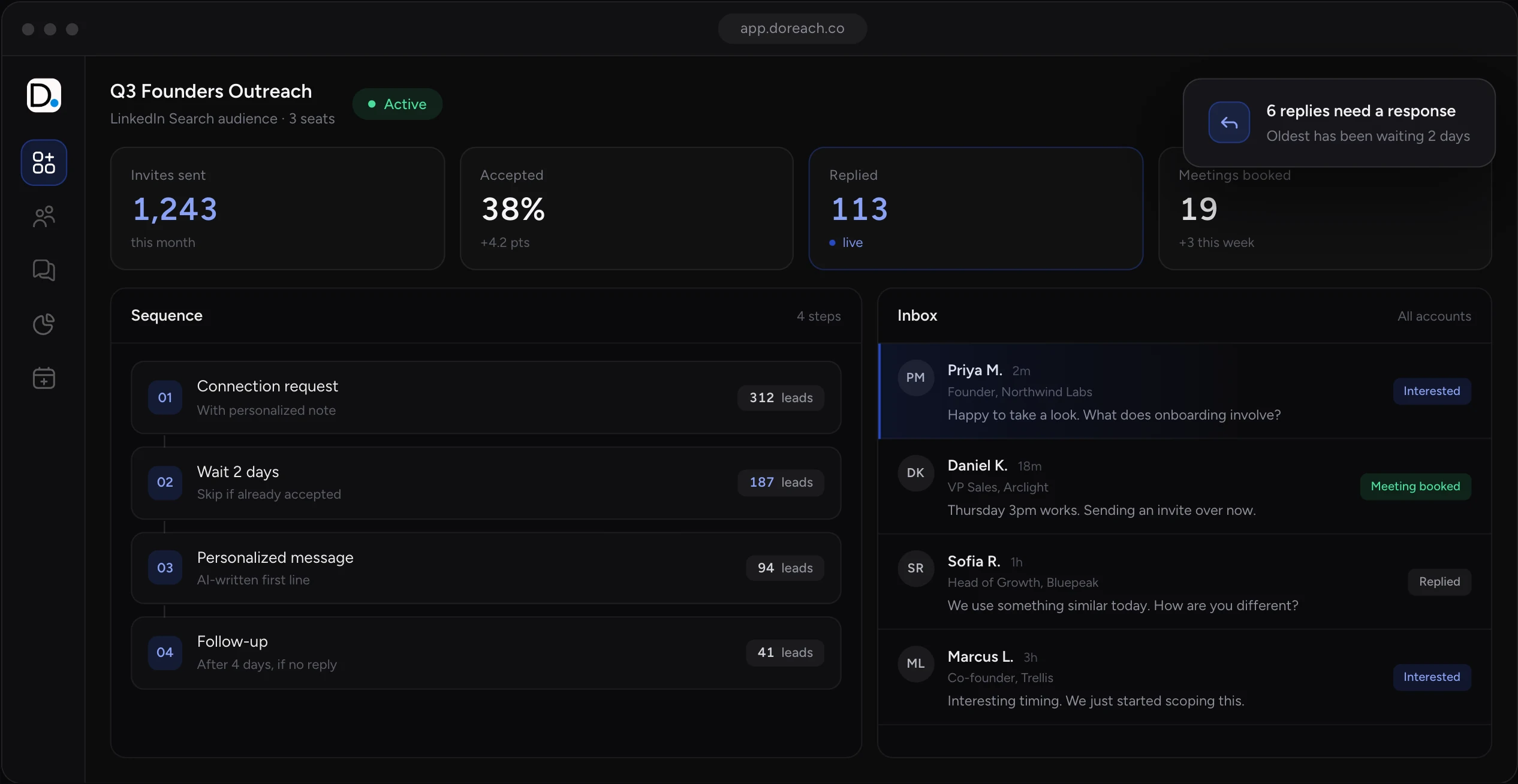
When you create a campaign in Doreach, you choose the audience source before writing the sequence. For LinkedIn, the sources are LinkedIn Search, post engagers and group members. You can also start from a saved audience or a CSV import, and the same builder offers Instagram followers, Instagram post commenters and your Instagram and WhatsApp chats. Event attendees appears as Coming soon and cannot be selected. Audience sources explains the categories, while campaign types and sources shows the current builder.
Doreach filters duplicate people within the selected audience. It also removes prospects already in the team’s CRM or another campaign. To include people you have messaged before, turn on Allow contacts who were in earlier campaigns on the Schedule tab. Anyone being messaged by another campaign right now is still left out. The sequence editor blocks invalid merge tags and spintax before you continue. Personalization and variables lists the supported tags and syntax.
Each connected account starts at 80 connection requests, 100 messages, 150 profile views, and 25 InMails a week. The account’s Limits panel shows each limit and its current weekly use. Limits and pacing explains how those account-wide limits work with campaign daily ranges and working hours.
What we would tell you not to do
Do not buy a scraped list and import it as profile URLs. It is a cold title filter you paid for, with worse data quality and no reason to connect.
Do not test the channel with a broad search containing thousands of people. You may conclude LinkedIn does not work when the test only measured a weak list.
Do not raise the limits to compensate. A weak list at higher volume creates more ignored and pending invitations. LinkedIn names both as possible reasons for an invitation restriction, and LinkedIn does not publish a universal safe number you can rely on.
Do not judge a post by its reach. Reach is the wrong metric when the post exists to produce a list, and the metrics that matter for founder-led outbound applies the same test to the rest of the funnel.
Start with one post
Find a recent post in your category with enough relevant reactions to form a useful test audience. Build your next audience from the people who engaged with it. Keep the sequence unchanged and compare its acceptance and reply rates with your last filtered-search campaign.
If the engagement list performs no better after a fair sample, review the message next. The founder-led prospecting playbook gives you a practical sequence to test.