The pitch for LinkedIn automation is that it saves time. That part is true. The part that gets skipped is what it does not save you from.
It does not choose who to contact, and it does not write anything worth reading. Those two decisions still determine your results, and automating around them just produces the same campaign faster.
What automation actually removes
The genuinely repetitive work: sending requests one at a time, remembering who to follow up with and when, checking which conversations already got replies, and doing all of it across several connected accounts.
That work is real and it caps volume. Removing it is worth paying for.
What it does not remove
Choosing the audience. A tool can pull from a search, a post’s engagers or an event’s attendees. Deciding which of those is the right group for this campaign is judgment.
Writing the message. Generated outreach is recognisable, and prospects have read enough of it to spot the shape at a glance. The copy that works is copy a person wrote. What tooling adds is variation and pacing, so one message you wrote reaches two hundred people without arriving as two hundred identical strings.
Deciding whether the offer is right. No sequence fixes a message nobody wants.
The safety part, honestly
LinkedIn’s user agreement prohibits automated access. Enforcement is real, and in practice it tracks behaviour rather than tools.
What draws attention: bursts of activity, sending at 3am local time, hundreds of requests to people with no plausible reason to accept, and the resulting ignored-request rate.
Doreach’s defaults exist because of this:
| Action | Default per account per week |
|---|---|
| Connection requests | 80 |
| Messages | 100 |
| Profile views | 150 |
| InMails | 25 |
Plus a randomised five-to-thirty-minute gap between actions and working hours set in the account’s own timezone. Roughly fifteen requests a working day, which is what an active person does.
If you need more, add another connected account rather than pushing one profile harder.
Where teams go wrong
They automate a campaign that was not working manually.
If your acceptance rate is under 20% by hand, automation multiplies the ignored requests. LinkedIn lists invitations that are ignored, left pending or marked as spam as one of two reasons it restricts an account from sending invitations. You get worse results and more risk at once.
Prove the campaign at fifty prospects. Then automate.
What good looks like in practice
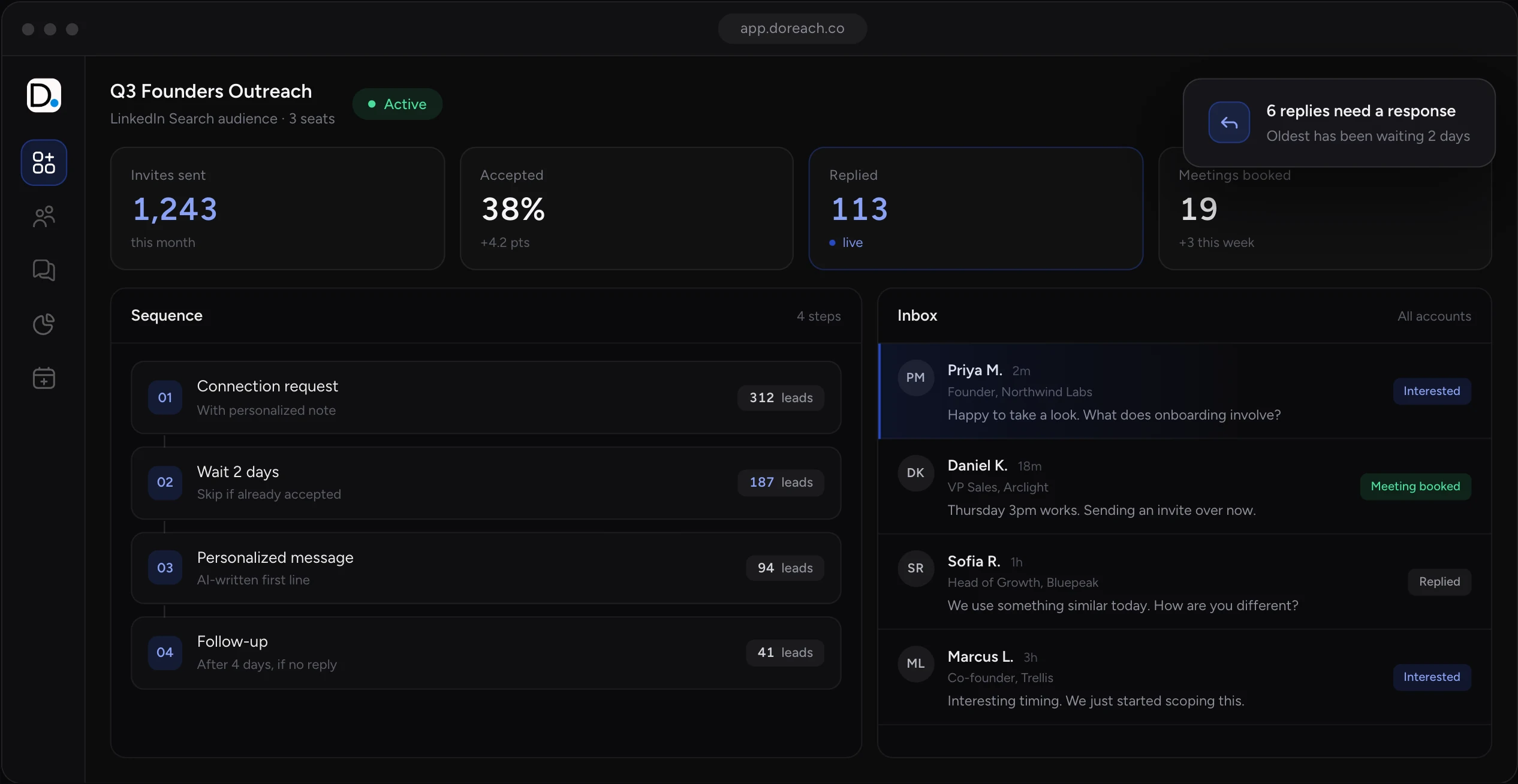
One connected account, a tight audience from a warm source, a three or four step sequence with real gaps, spintax varying the wording, and replies pulling people out of the sequence automatically into a shared inbox.
That is not glamorous and it is most of the value.
What to do next
Look at your last campaign’s acceptance rate before you look at any tool. Above 30% and automation will multiply something that works. Below 20% and the audience is the job for this week.