Founder outbound has a measurement problem: it looks like sales and it is mostly research.
If you judge it on meetings booked in month one, you will conclude it does not work and stop, right before it starts telling you the thing you needed.
The two jobs
Pipeline. Meetings, opportunities, revenue. Slow at first, and the reason most founders quit.
Learning. Which segment responds, which objection recurs, what language they use for the problem. Fast, and worth more in the first quarter.
Track both. Reporting only the first makes a working programme look like a failing one.
The numbers, in order
Acceptance rate. Is this the right audience? Belkins’ 2025 LinkedIn outreach study puts the average at 26%. Below 20%, well under that average, and the list is wrong. No message rewrite fixes it.
Reply rate. Does the message work, given that the list was right?
Positive reply rate. Does the offer work? This is the one that tells you whether the thing you built is the thing they want.
Segments tested. How many distinct audiences have you run properly? One tested at a hundred contacts beats five tested at twenty.
Objection distribution. Which objection comes up most. This is your roadmap and your homepage copy, arriving free.
The handover problem
Founders get replies reps do not. The title opens doors, and a founder can have an unscripted conversation about the product that a new SDR cannot.
So a campaign at 12% reply rate in your hands may run at 5% in theirs. That is not a failure of the rep, it is the founder premium disappearing.
Plan for it: record what you actually say when a conversation goes well, and hand that over rather than the sequence.
Sample size
A hundred contacts per segment before drawing any conclusion. Below that you are reading noise and making expensive decisions from it.
At safe sending limits, roughly 80 connection requests per connected account per week, a hundred contacts is a week and a half. That is the real pace of founder outbound and it is worth setting expectations around, because the temptation to push volume is exactly what puts the account at risk.
Where this shows up
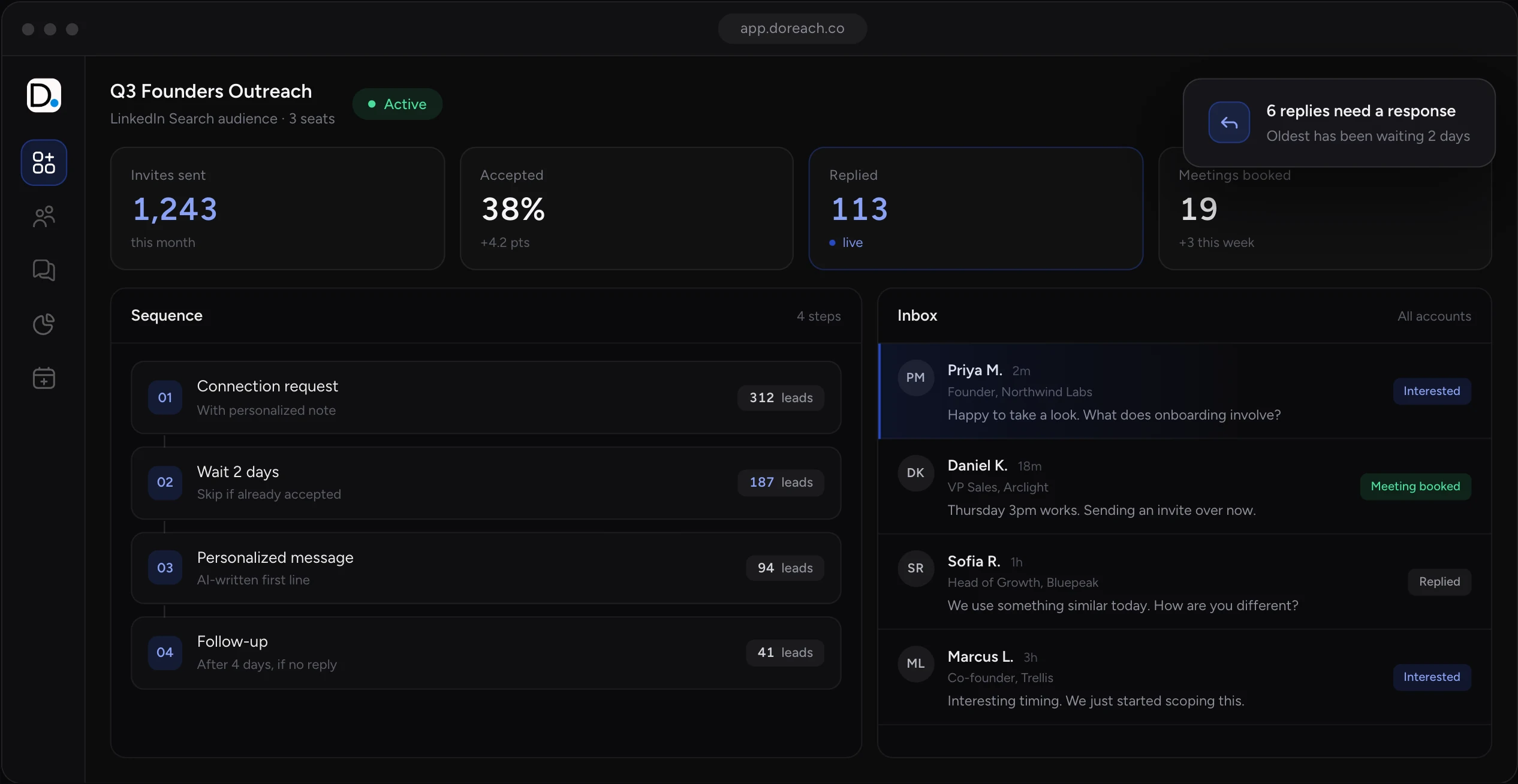
Doreach reports enrolled contacts, replies and meetings for each campaign, and invitations sent and accepted for each channel and account, so comparing two segments on the same axis is straightforward. Analytics covers what is tracked.
The habit worth building: one campaign per segment, never mixed, so the comparison means something.
What to do next
Write down the three or four segments you think might be your market. Run one campaign per segment to a hundred people each. The one with the highest positive reply rate is where the next quarter goes.