A company on your list announces a Series A on Tuesday. By Friday, its founder has a pile of messages that start with “Congrats on the raise!” and end with a request for 15 minutes. Most of them probably get no reply, and the founder could not tell you what any of them were selling.
The announcement was a real reason to write. The problem is that everyone saw it, and almost everyone wrote about the announcement itself. This post is about writing about the part only you can see: what the news changes for that company, and why that might matter to what you sell.
The short version
A piece of company news is a sales signal when it changes what the company needs. A funding round means hiring and spending. A launch means the company needs customers, feedback and support. An expansion means new people, new rules and new problems in a new place. A partnership means integration work and joint selling.
Write one clause about the news, then spend the rest of the message on the consequence that connects to your offer. If you cannot name a consequence that connects, do not write. The news is a reason to look at the company, not a reason to message everyone at it.
For the broader set of signals, including hiring posts and person-level activity, see the prospecting signals worth tracking. The rest of this post covers company news only.
Which company news is worth a message
Four kinds of news come up again and again in B2B outreach. Each one creates different work for the company, and each one suits a different kind of seller.
| News | What usually changes for them | Who it suits | What to leave out |
|---|---|---|---|
| Funding round | Hiring plans, a new budget, pressure to grow fast, tools that worked for ten people stop working for fifty | Recruiters, agencies, tools for a team that is about to grow | The size of the round, and any guess at their valuation |
| Product launch | They need first customers, reviews, onboarding and support for something new | Marketing and growth agencies, customer success and support tools | An opinion on the product itself unless you have used it |
| Expansion (new office, country or market) | Local hiring, local rules, a sales team that does not know the market yet | Local agencies, recruiters, compliance, payroll and logistics services | Assumptions about why they chose the market |
| Partnership | Integration work, a joint launch, a new audience to sell to together | Development shops, partner marketing, companies that already serve the partner's customers | Claims about the partner you cannot check |
The last column matters as much as the third. A message that quotes the round size back to a founder reads as if you skimmed a headline and reached for the nearest fact. A message that tells them why they chose a market reads as a guess, and a wrong guess ends the conversation.
Write about the change, not the announcement
The announcement is public. Everyone who follows the company knows about it. What you add is the next step: the thing the news makes harder, slower or more urgent.
Here is the difference in one line each:
- About the announcement: “Congrats on the Series A, exciting times!”
- About the change: “With the Series A done, I imagine the next six months are mostly hiring engineers.”
The second line gives the reader something to agree or disagree with. Both answers are useful to you. “Actually, we are hiring sales first” is a reply, and it tells you more than a polite “thanks” would.
Keep the reference to one clause. Repeating the details of their own news back to them, the amount, the lead investor, the quote from the press release, reads as surveillance rather than interest. One clause shows you know why you are writing this week. The rest of the message is about them and the problem.
What we would tell you not to do
Do not send the same message to every company that posted news this week. If your template works equally well for a funding round, a launch and a new office, it says nothing about any of them. Write one message per kind of news, and if your offer fits none of the four, leave the company off the list for now.
Do not pretend the news is why you chose them if it is not. A company that was already on your list is fine to contact because of its news. Saying “I have been following you for months” when you found them in an alert yesterday is the kind of claim that one question exposes.
Sample messages for each kind of news
The samples below are short enough for a LinkedIn message or the first lines of an email. Swap every detail for something true about your own prospect and your own work. If you sell software, start from the fifth sample; the shape is the same for any seller.
Funding round, for a recruiter:
Hi Dana, with the round closed, I expect the next few months are mostly engineering hires, faster than the founders can interview for them. We place backend engineers for Series A companies in fintech and usually send a first shortlist within ten days. Is engineering hiring the priority this quarter, or is it sales first?
Product launch, for a growth agency:
Hi Sam, saw the launch of the new reporting feature. The hard part after a launch is usually getting the first fifty teams to try it, not building it. We run launch campaigns for B2B software and could share what worked for a similar feature last spring. Who is looking after adoption on your side?
Expansion, for a local service:
Hi Priya, I saw you are opening in Germany. Hiring your first local team usually means German contracts and payroll sooner than people expect. We set up employment for companies entering Germany without a local entity. Is the first hire already in place, or still being planned?
Partnership, for a development shop:
Hi Alex, the Shopify integration you announced last week looks like a fair amount of build work on both sides. We have built Shopify integrations before and could take part of the build off your team’s plate. Is it being handled in house?
Funding round, for a software seller:
Hi Jordan, now that the round is closed, I imagine the sales team is about to grow. Teams that add reps quickly usually find the spreadsheet they track deals in often stops working as the team grows. Our tool gives every new rep the same pipeline view from day one. Is sales the team growing first?
All five samples follow the same shape: one clause on the news, one sentence on what it usually means, one sentence on what you do, one question that is easy to answer. If you send email, the cold email follow-up guide covers what to send after the first message.
How soon to reach out after the news
The first 48 hours after a funding announcement are the noisiest. The founders are fielding investors, press, candidates and every vendor in their category. A message that lands then competes with all of them.
Our view is that a message a week or two later, tied to a specific consequence, often stands out more than a fast one. By then the congratulations have stopped, and the work the news created has started. A month later the news is still a natural reason to write. After about three months it is history, and mentioning it makes you look late.
Launches and expansions are different. The first days after a launch are when a company most wants attention for it, so a message about the launch is welcome sooner. An expansion usually takes months to happen after it is announced, so the useful window is longer.
Where to find company news
You do not need a paid tool to start. These sources are free, and between them they cover most announcements:
- Company LinkedIn pages. Most companies post funding, launches and new offices on their own page first. Watching the pages of companies already on your list is the most targeted source there is.
- Press and newsroom pages on the company’s own site.
- Funding news sites such as Crunchbase News and TechCrunch, which publish rounds daily. These are the usual answer to “where can I find recently funded startups”.
- Investor announcements. Venture firms post their new investments on their own sites and LinkedIn pages.
- Job posts. A sudden run of openings in one team at one company is often the first public sign that a round has closed or an expansion has started.
- News alerts for the names of your target companies.
The catch with all of these is the reading. A keyword alert for “launch” also catches a webinar launch, a podcast launch and a post about someone’s launch party. An alert for “raised” catches “we raised the bar”. You will spend more time ruling out matches than writing messages, unless something does the first pass for you.
How company news signals work in Doreach
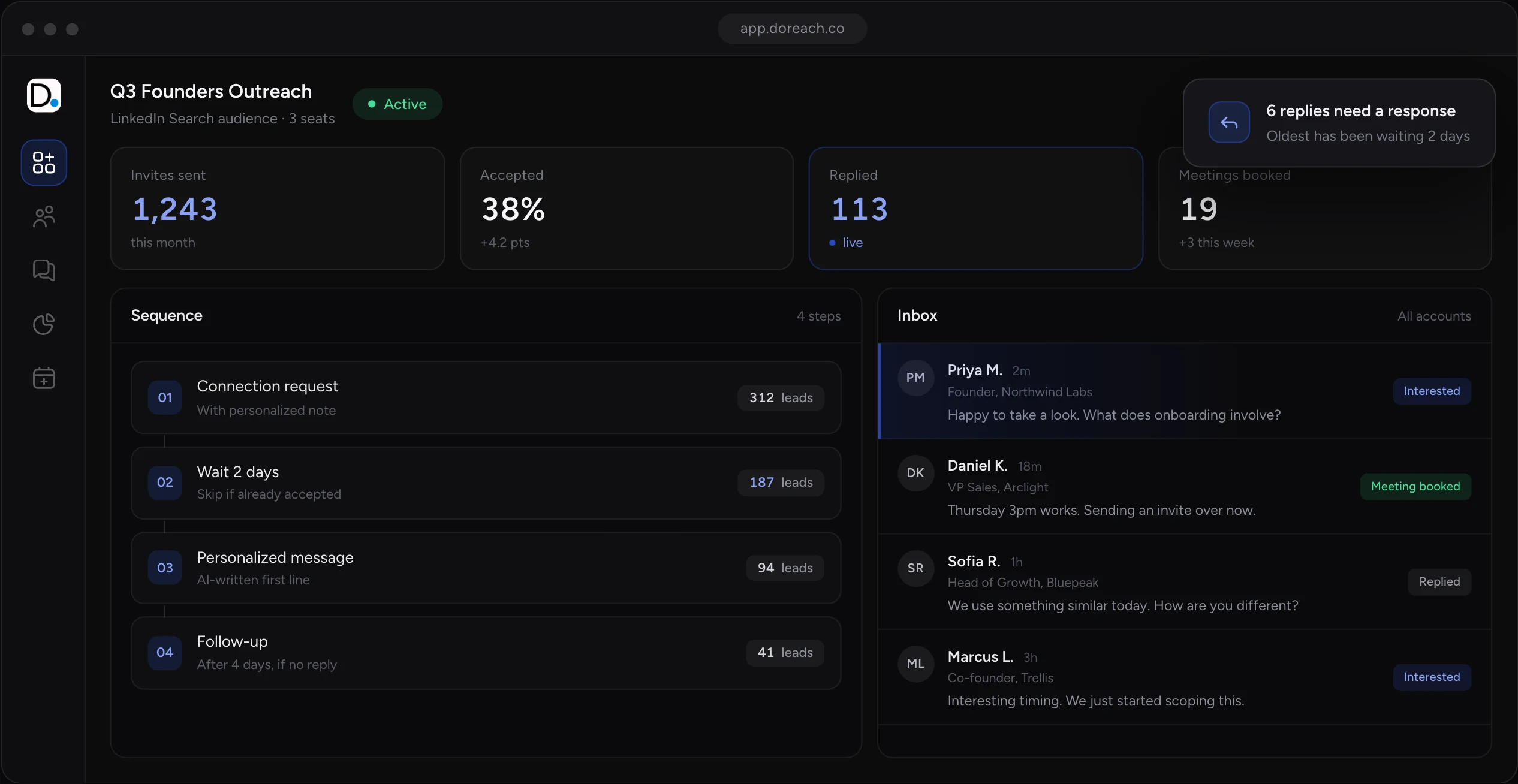
In Doreach, company news is a campaign audience. With a connected LinkedIn account, choose Companies in the news as the source when you build a campaign, and make four decisions:
- Which companies. Up to 200, added by name or as a CSV of LinkedIn company page URLs.
- Which news. Funding, Product launch, Expansion, Partnership, or a Custom topic of up to six keywords of your own, such as “acquisition”.
- How recent. Posted in the past day, week or month.
- Who to reach. A job title or keywords, up to three people per company.
Doreach looks for those posts on the companies’ LinkedIn pages, and AI reads each one before it counts. A webinar invite that says “launch” is set aside with the reason shown, and you can add it anyway if the AI got it wrong. AI sales signals explains the check. Keyword matching on its own is loose, so every match waits in a review list by default, next to the post the company made, and you approve each person before their sequence starts. We would keep review on until you trust what a campaign finds.
The campaign keeps looking every day, every three days or every week, as you choose. Nobody is added twice, and people who are blocked or already in another running campaign are left out. Signals covers the other signals, such as hiring posts and Instagram posts.
One practical tip. Doreach’s merge tags cover the person, not the company, and there is no company tag (merge tags and fallbacks has the current list). So build one campaign per kind of news, and write each message to its news: the funding campaign talks about what the round means for hiring, the expansion campaign about the new market. One message per kind of news is the advice from earlier in this post anyway. The sequence steps page explains what you can add after the first message.
What to do next
Pick the one kind of company news that most often creates work you can help with. For most sellers, that is either funding or expansion. Write one message for it in the shape above: one clause on the news, one sentence on what it changes, one on what you do, one easy question.
Then pick ten companies you would want to hear from if they announced that news tomorrow, and watch them this week, by hand on their LinkedIn pages or with a Companies in the news campaign in Doreach. When the first one posts, send your message within two weeks, and note whether the reply talks about the change you named.