You found a company that could clearly use your help. You open a blank email, type “I hope this finds you well”, delete it, and wonder how to ask a stranger for business without sounding like every other email they deleted this morning.
Copying a template will not solve that. A template gives you the shape of an email, but the part that earns a reply is the part only you can write: why you chose this company. So here are four samples sorted by situation, along with what makes each one work and what to swap before you send it.
The short version
A first email to a potential client needs four things: the reason you chose them, the problem you noticed, one relevant result, and one easy question. As a rule of thumb, keep it under about 100 words and send it in plain text.
Before you send, apply one test. Would this email still make sense sent to any company? If it would, it is not ready. Find one true detail about this prospect, or leave them off the list for now.
The four parts of a first email
Each part answers a question the reader has in the first few seconds. Samples 2 and 4 below swap the result for something small you can offer, which is also what to do if you have no results yet.
| Part | The reader's question | Weak version | Better version |
|---|---|---|---|
| Reason | Why me? | I came across your company and was impressed | I saw you are opening a second location on the east side |
| Problem | Why now? | Many businesses struggle with growth | Costs often land in the wrong place once there is a second site |
| Proof | Why you? | We are a leading provider of tailored solutions | I set up reporting by site for a two-location group last year |
| Question | What do you want? | Do you have 30 minutes this week for a call? | Is this on your list before the opening? |
The last row matters most. A meeting request asks a stranger to give up part of their calendar before they know whether you are worth it. A yes-or-no question takes five seconds to answer, and a one-word reply opens the conversation you wanted.
Write the subject line last, once you know what the email says. Our guide to cold email subject lines has more examples by situation.
Sample emails to a potential client, by situation
The names, companies and results below are made up to show the shape of each email. Replace every one with something true.
Sample 1: a service business writing to a new client
Use this when you sell a service and something public has changed at the company: a new site, a new product, a new hire.
Subject: the east side opening
Hi Dana,
I saw you are opening a second location on the east side. Most restaurant groups I work with find their books get messy around the second site, because costs start landing in the wrong place.
I set up separate reporting for each site for a two-location group last year, and their owner now sees each kitchen’s margin every month.
Is this on your list before the opening?
Sam Reed, Reed Bookkeeping 120 Main Street, Springfield This is a sales email. Reply “no thanks” and I will not write again.
The last two lines show the postal address, ad disclosure and opt-out information covered further down. Add those details to every commercial email. The email works because the change at the company supplies the reason for writing. The problem is one the owner can picture, and the proof is about one client like them, not a list of services.
Swap in your own trigger, your own client type and a result you can talk about on a call.
Sample 2: an agency writing to a brand
Use this when you can show a specific idea, because agencies are easy to ignore when they only describe themselves.
Subject: your returns page
Hi Marcus,
I was looking at your site before buying the trail shoes and noticed the returns policy is three clicks from the product page. Buyers who are unsure of their size often want that answer before they add to cart.
I sketched how it could sit next to the size guide. Should I send it over? It is one image and there is nothing to buy.
Lena [Your valid postal address] This is a sales email. Reply “no thanks” and I will not write again.
Nothing here says “we are a full-service agency”. The email shows the kind of thinking the client would be paying for, then offers something small. The reader can say yes without feeling they have started a sales process.
Only offer the sketch if you have done it, or can do it the same day they reply.
Sample 3: a SaaS company writing to a team lead
Use this when a hiring post, a job change or a new tool tells you what a team is working on. Job posts are useful because the company has said in public what it is trying to fix.
Subject: your two SDR openings
Hi Alicia,
I saw you are hiring two SDRs. New reps often spend their first weeks learning which accounts have already been contacted, and who owns them.
Our onboarding tool shows each rep that history before they send anything. [One real result goes here, from a team like theirs.]
Is onboarding on your plate for these hires, or should I ask someone else?
Tom [Your valid postal address] This is a sales email. Reply “no thanks” and I will not write again.
The closing question gives the reader an easy way to answer even if they are the wrong person. Asking “should I ask someone else?” is often how a cold email reaches the right person, and it sounds polite because it is a real question.
Sample 4: when someone referred you
Use this only when the other person has agreed to be named. A name the reader knows is the strongest reason to open an email, and using it without permission can cost you two relationships at once.
Subject: intro from Priya Shah
Hi Oliver,
Priya Shah suggested I write to you. She mentioned you are looking for help with the Dubai office lease and setup, and I handled the same move for her team last year.
Would it help if I sent the checklist we used? You can decide from there whether a call is worth your time.
Nina [Your valid postal address] This is a sales email. Reply “no thanks” and I will not write again.
The referral does the work of the first two parts, so the email can be shorter than the others. Name the person in the first line and say what they told you.
How this works in Doreach
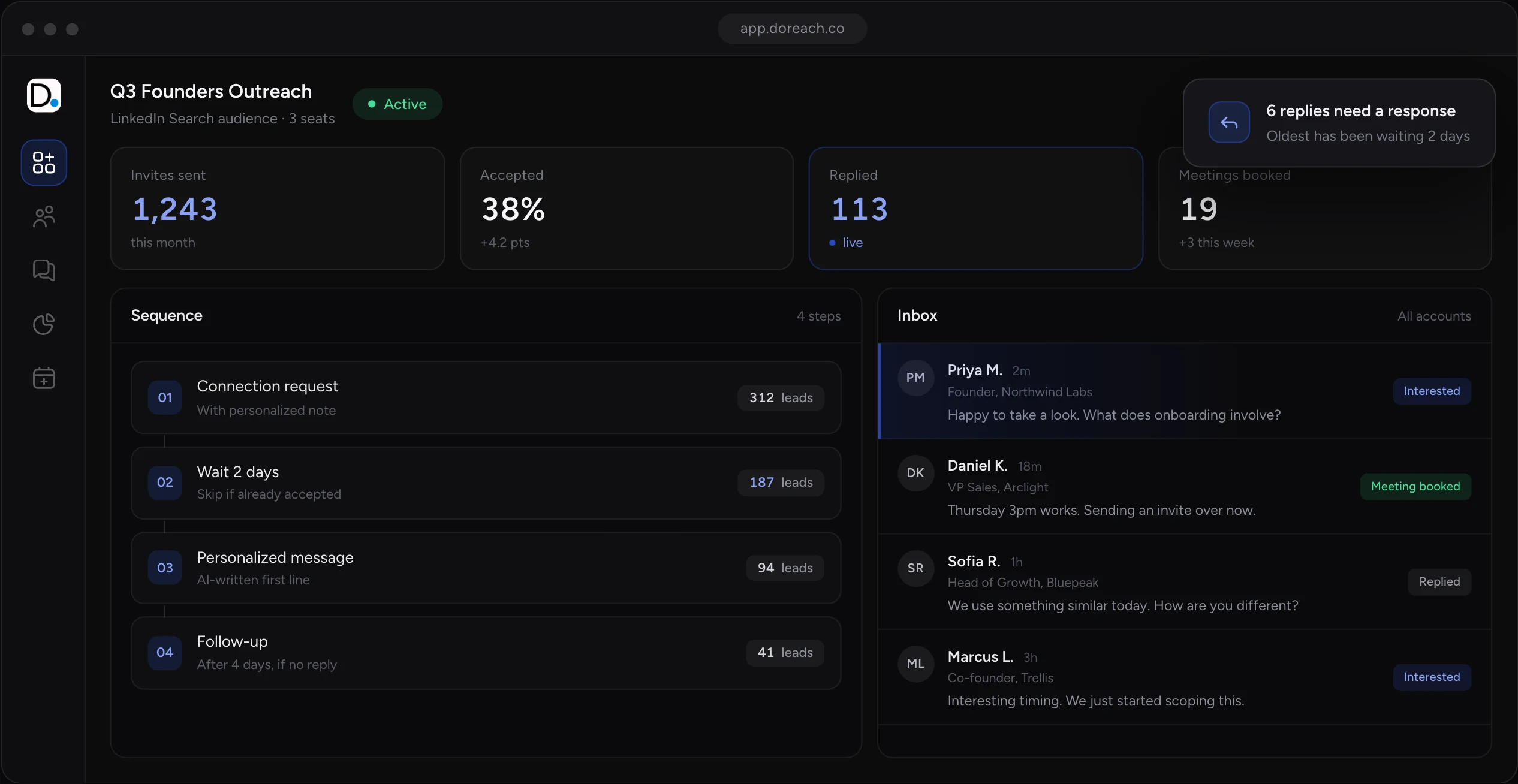
In Doreach, a cold email goes out as an Email step in a campaign, from your own mailbox, such as Gmail or Outlook, or any other SMTP and IMAP mailbox. The subject and body both accept merge tags, so {{first_name|there}} fills in the person’s first name and falls back to “there”. {{referred_by}} fills in the person who pointed you to them. Merge tags and spintax has the current list.
Doreach has no company tag, so the reason for writing comes from how you build the list. We would split it by situation and run one campaign for each: everyone hiring SDRs in one, everyone opening a new site in another. Bring each list in with a CSV import, then open the message with a line that is true of everyone on it, such as “I saw you are hiring SDRs”. For your few best prospects, write the email by hand.
On the campaign’s Schedule tab, choose Plain text (recommended) under Email format. The Unsubscribe option is on by default and adds a plain line at the end of every email, plus the one-click header mail apps use. Stop on reply is also on by default, so anyone who answers gets no more follow-ups and you do not have to track who replied. Their reply lands in your unified inbox.
Your postal address is yours to add, so put it in your signature. If you need more than one mailbox, multiple sender accounts spreads a campaign across them, which most cold email tools call inbox rotation. To follow up somewhere other than email, add a LinkedIn message as a later step in the same multi-channel campaign.
What the law asks of a cold email
The CAN-SPAM Act does not ban unsolicited commercial email, but every covered message has to meet its rules. The FTC’s compliance guide says the law “makes no exception for business-to-business email”, so writing to a company address does not exempt you.
Five of its rules affect a first email directly:
- Use accurate sender information. Your From, To, Reply-To and routing information must identify the person or business that sent the message.
- Be honest in the subject. The subject line must accurately reflect the content of the message.
- Disclose that it is an ad. A commercial message must say clearly that it is an advertisement. The FTC leaves the wording open, so a plain line like the one in sample 1 is a reasonable way to do it.
- Include a valid postal address. A street address or a registered post office box both count.
- Offer an opt-out. Explain how to opt out, and honor the request within 10 business days.
Canada, the UK and the EU have their own rules, which are different from these, so check the law where your prospects are before you send. None of this is legal advice.
What we would not do
- Invent the proof line. A made-up client falls apart at the first question on a call. If you have no result to point to yet, offer an idea or a small first project, as in sample 2.
- Fake familiarity. “Loved your recent post” with no detail about the post tells the reader that software wrote the line.
- Attach a brochure. A cold attachment is one more thing to distrust, and the reader did not ask for it.
- List everything you do. One relevant result is more believable than eight services, and it gives the reader one thing to answer.
- Send the samples above word for word. They only work with facts that are true about your prospect and your own work.
What to do next
Pick five companies you would like to work with. For each one, write down one thing that has changed there in the last three months, and leave a company off the list if you cannot find anything.
Then write one email using the four parts, read it out loud, and check it against the test: would it still make sense sent to any company? If you already send at volume, run the same check on your largest campaign and split out any list that has no shared reason for writing. Plan the second and third emails before you send the first, because a first email often gets no answer. Our guide to cold email follow up covers the timing and what each one should add. Which of your five companies has something you can mention today?