You sent a good cold email on Monday. It is now Thursday, nobody has answered, and you are trying to decide whether a second email is persistence or pestering.
Send one useful follow-up. A first email can be missed, but that does not justify repeating the same pitch. Timing, new information and a clear stopping point decide whether the next email earns its place.
The short version
Wait three to four business days. Reply in the same thread. Add one new thing. Keep it shorter than the first email. As a starting point, Doreach recommends three or four emails in total over two to three weeks. Make the last one say clearly that you are stepping back.
Do not send a follow-up that only says “just following up” or “bumping this”. That email asks the prospect to scroll down and work out why they should answer. Give them a new reason instead.
When to send each follow-up
The gaps should get wider, not stay equal. A tight first follow-up catches the person who meant to reply and forgot. Wider later gaps stop the sequence from feeling like a drip of pressure.
Here is the cadence we would start with for a cold email sequence. Treat it as a starting point you adjust to your market, not a law.
| Send it | Its job | Length | |
|---|---|---|---|
| 1. First email | Day 1 | Say why you are writing to this person and ask one question | 50 to 120 words |
| 2. First follow-up | 3 to 4 business days later | Add one new angle or a specific example | 30 to 60 words |
| 3. Second follow-up | About 5 days after that | Make the ask smaller, or offer something useful with no ask attached | 30 to 60 words |
| 4. Last email | About a week after that | Say you will stop writing and leave an easy way back | 2 to 4 sentences |
Count business days, not calendar days. Keep each follow-up inside the prospect’s working week and send window.
Send follow-ups at the same time of day as the first email, in the prospect’s working hours. If your list spans time zones, the send window matters more than the exact day.
Three or four emails is the starting point
Doreach recommends starting with three or four emails in total. We would not start with a longer sequence.
With stop on reply enabled, every later email goes to a smaller group that has not answered the earlier ones. Each extra send needs a new job because it also creates another chance for someone to unsubscribe or report the message as spam.
Google’s sender guidelines tell senders to keep the user-reported spam rate in Postmaster Tools below 0.1% and avoid reaching 0.3%. Postmaster Tools also reports domain and IP reputation. A shorter sequence does not guarantee good delivery, but it gives you fewer low-value sends to defend.
There is one exception worth naming. If a prospect replies “not now, try me in March”, that is not a sequence that ran out. Put a reminder in for March and start a fresh, short conversation then.
What to put in each follow-up
A follow-up earns its place by carrying something the first email did not. Here are four options to test:
- A narrower angle. Your first email was about outbound in general. The follow-up names the one thing that applies to their team: “You are hiring two SDRs this quarter, so the first month of ramp is probably on your mind.”
- A specific example. One sentence about a similar company and what changed for them. A real one, named if you have permission.
- A smaller ask. If the first email asked for a 30-minute call, the follow-up asks a yes-or-no question they can answer from their phone.
- Something useful with no ask. A link to a resource that is genuinely about their problem, not your product page.
Keep the follow-up shorter than the first email. The prospect can see your first message right underneath, so there is no need to restate it.
End on one question. “Is this on your list for this quarter?” is easy to answer in five words, including with a no. A no is useful because it tells you to stop.
The last email should do what it says. Something like: “I will stop writing about this. If outbound comes up later in the year, reply to this thread and I will pick it up.” Use no guilt and no fake deadline. Then stop the sequence.
Keep the thread, keep the subject
Send follow-ups as replies to your first email, with the same subject line. The prospect opens one thread and sees the whole conversation, which is why the follow-up can be two sentences long.
Two common mistakes go with this:
- Changing the subject line on each follow-up. Each one then looks like a separate cold email from a stranger, and the context you built is gone.
- Faking a reply. Putting “Re:” on a first email falsely suggests an ongoing conversation. Do not trade a clear subject line for that trick.
Start a new thread only when you are genuinely starting a new conversation, for example months later with a different reason to write.
The follow-up does not have to be another email
People pay attention to different channels. A prospect who misses an email may see a LinkedIn message. Use WhatsApp only when the person has given you their number or username and opted in to receive messages, as required by the WhatsApp Business Messaging Policy.
So one of the touches can be on another channel. A typical shape is: first email, follow-up in the same thread, then a LinkedIn connection request or message a few days later, then the last email. Each touch refers to the others lightly (“I sent you a note by email last week about…”) so the person knows it is one conversation, not two salespeople.
Switching channel is an option, not a rule. The moment the person replies anywhere, stop every remaining step on every channel. A later email after a LinkedIn reply tells the prospect that the channels are not coordinated.
How this works in Doreach
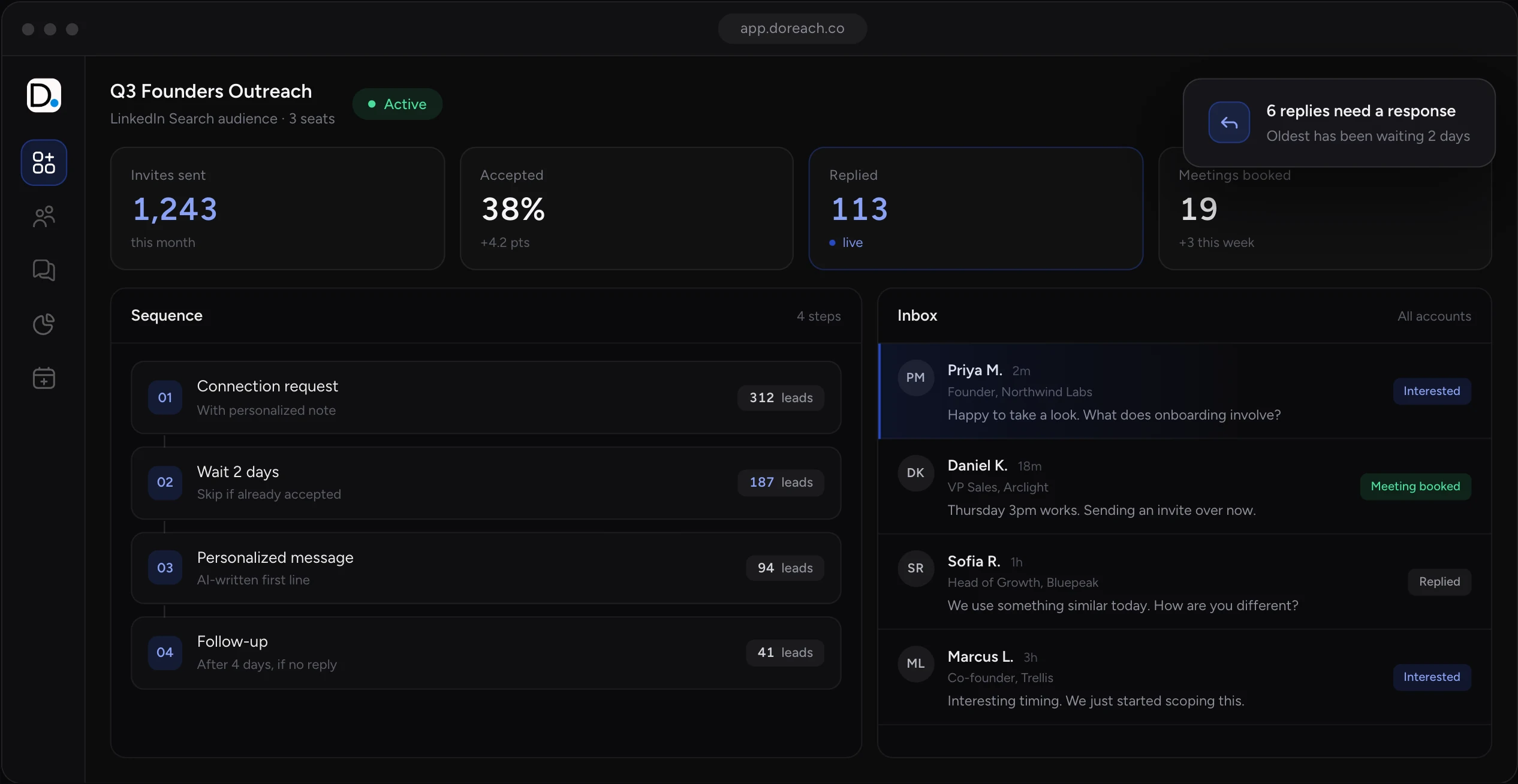
In Doreach, a follow-up sequence is a campaign with steps. You add an Email step for the first message, then another Email step for each follow-up, and set When it sends on each one to the wait you want after the previous step. On the second and later email steps there is a switch, Send as a reply to the previous email. Turn it on and the subject field disappears, because the follow-up reuses the subject of the earlier email and lands in the same thread.
Emails go out from your own Gmail, Outlook or IMAP mailbox. Each mailbox has a daily sending limit and a random gap between emails, which you can change; the defaults and the range are on the limits and pacing page.
Stop sequence on reply is selected by default on the schedule screen. When someone replies, their remaining steps stop, and the reply lands in the unified inbox. Out-of-office replies are recorded but do not stop the sequence unless you also tick the option to stop on automatic replies. You can clear stop on reply for a campaign if you want it to carry on. Doreach also adds an unsubscribe line to the end of each email unless you turn it off, and a click on it stops that person’s sequence.
If you have the required contact details and permission for the channel, add a LinkedIn, Instagram or WhatsApp step to the same campaign. With stop on reply on, a reply on any channel ends the remaining steps for that person. Multi-channel outreach shows the channels you can mix, and sequence steps explained covers delays and step types in detail.
What we would not do
- Send a follow-up with nothing new in it. If you cannot think of something to add, the sequence is one email too long.
- Start with more than four emails to someone who has not replied. Begin with a shorter sequence. Add a step only when it has a clear job and new information.
- Guilt the prospect. “I guess you are too busy” or “Did I do something wrong?” makes it harder for them to reply, not easier.
- Keep sending after a reply on another channel. Check that your tool stops the whole sequence, not just the email steps.
- Write the follow-ups after the first email goes out. Write the whole sequence before you launch, so each email has a planned job and you are not improvising on day eight.
What to do next
Open your last cold campaign and read the follow-ups on their own, as if you had never seen the first email. If any of them would make you think “so what?”, rewrite it around one new angle and one easy question.
Then decide your stopping point before you launch the next one: three or four emails, the gaps from the table above, and a clear last email. If you are still writing follow-ups by hand, Doreach sequences will send them on schedule from your own mailbox and stop them when someone answers. For the follow-up after a LinkedIn connection, read our LinkedIn follow-up strategy, and for the first email itself, outbound copywriting principles.