The useful question is not “what can be automated.” Nearly everything can. It is “what should be,” and the dividing line is whether the task requires a decision.
Automate: the identical work
Sending on a schedule. Requests going out at a steady pace across working hours, rather than in the twenty minutes an SDR has free on Thursday.
Follow-up timing. This is the biggest one. Most replies come on touch two or three, and manual follow-up across two hundred prospects is precisely what stops happening when the week gets busy.
Tracking who replied. Tedious, error-prone, and completely mechanical.
Spreading work across accounts. More connected accounts means more capacity without pushing any single profile past its safe limits.
Keep human: the decisions
Choosing the audience. A tool can pull a list. Deciding it is the right list is judgment, and it is the decision that determines everything downstream.
Writing the message. Copy is a judgment call, and prospects can tell when it was not one. Write it once, then let spintax and merge tags carry it to two hundred people without it arriving identical.
Replies. All of them. This is where automation should visibly end.
Deciding an account is worth pursuing. No system knows that.
The reply boundary
Worth stating plainly because it is what people fear most about automation.
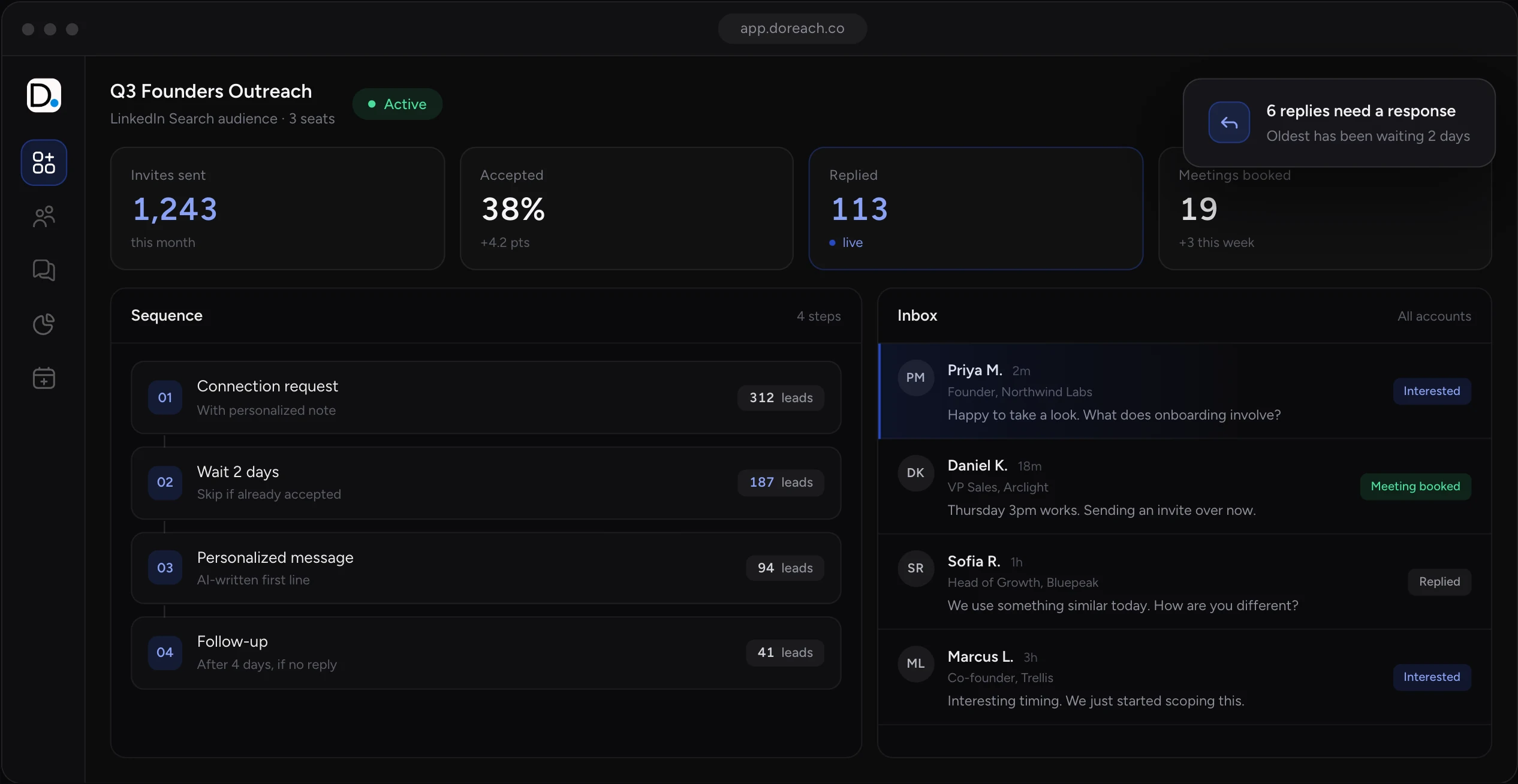
In Doreach, when a prospect replies, their remaining sequence steps are cancelled automatically. Nobody gets a scripted follow-up to a conversation they already started. It is on by default, and the conversation lands in the unified inbox for a person to pick up.
That single behaviour is what separates automated outreach from spam in practice.
Automation does not fix a broken process
If reply rate is 2% manually, automating produces 2% at higher volume, plus more ignored requests, plus more account risk. Ignored requests are one of the two reasons LinkedIn gives for restricting invitations, so a bad campaign gets more dangerous as it scales.
Get one campaign working at fifty prospects. Then automate it.
The pacing that makes it survivable
Doreach defaults to 80 connection requests per connected account per week with a randomised five-to-thirty-minute gap and a sending window in your team’s timezone. Details in limits and pacing.
Those numbers sit below what LinkedIn tolerates on purpose. Extra capacity comes from another connected account, not a higher ceiling on one profile.
What to do next
List everything your SDRs do in a week and mark each item as decision or no-decision. Automate the no-decision column, starting with follow-up scheduling. Leave the rest.