There is a version of AI outreach that works, and a version that gets you ignored.
The version that gets ignored is asking a model to write the message. The version that works is asking it to help you understand who you are writing to, then writing the message yourself.
This is about the second one.
Why not let it write
Generated outreach is recognisable. Not because the sentences are bad, but because thousands of people are prompting the same models and getting structurally identical results: the observation, the pivot, the soft ask.
Your prospect has read forty of them. That is the whole problem, and no prompt fixes it.
What to use it for instead
Summarising a company fast. Twenty minutes of reading compressed into two.
Surfacing likely priorities. What does a Head of RevOps at a 200-person Series B usually care about in Q3?
Generating angles. Five different reasons this segment might care, so you can pick the one you actually believe.
Pressure-testing your copy. Paste your draft and ask what a skeptical reader would object to.
Prompt structure that works
Four parts, in this order.
Audience. Who they are, specifically. Not “sales leaders” but “VP Sales at a 50 to 200 person B2B SaaS company that sells to mid-market.”
Signal. Why now. A funding round, a hire, a post they wrote.
Output. What you want back and in what shape. “Five bullet points” beats “some ideas.”
Exclusions. What to leave out. “Do not suggest anything about digital transformation. Do not write a message.”
A working example:
I am researching VPs of Sales at 50-200 person B2B SaaS companies that recently posted about hiring SDRs. Give me five specific operational problems they are likely dealing with in the first 90 days of an SDR hire. Be concrete. Do not write any outreach copy and do not include anything about culture or motivation.
Ask for questions, not claims
The most useful thing to request is questions you could ask a prospect, not facts about them.
A model asked for facts will invent them fluently. A model asked for good questions produces something you can verify in the conversation itself, which is where it belongs.
Verify before it reaches a message
Anything specific enough to be useful is specific enough to be wrong. Funding amounts, headcounts, product details, who reports to whom.
A generic opener is forgettable. A confidently wrong one ends the conversation.
Where this meets the sending
Once you have the angle, the writing is yours, and it should be, because a message you wrote is one you can defend when someone replies to it.
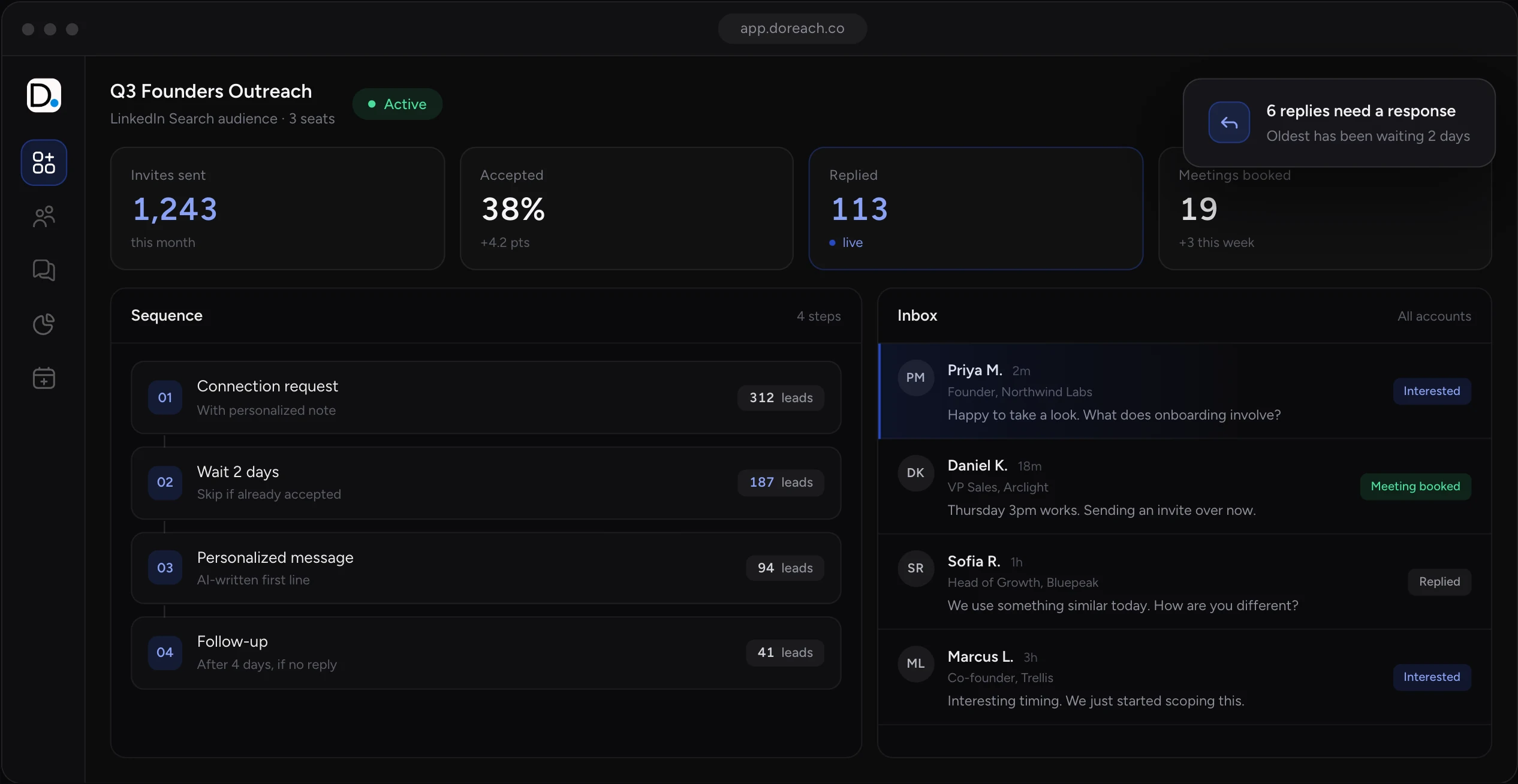
What Doreach adds from there is spintax and merge tags, so the message you wrote can go to two hundred people without arriving as two hundred identical strings.
What to do next
Take your next campaign and run one research prompt with all four parts before writing anything. If the output is generic, the audience definition in the prompt was too broad. That is usually also why the campaign underperforms.