You sent the first message eight days ago. No reply. You are not sure whether to send another, and while you decide, the moment passes.
That hesitation is where most outbound quietly dies. Not in the writing, in the not-sending.
Why follow-ups matter more than the opener
Most replies do not arrive on the first message. A good opener sent at a bad moment looks identical to a bad opener, and the only way to tell the difference is to try again a few days later.
Following up by hand across two hundred prospects is exactly the work that stops happening when the week gets busy. That is the argument for putting it in a sequence rather than a task list.
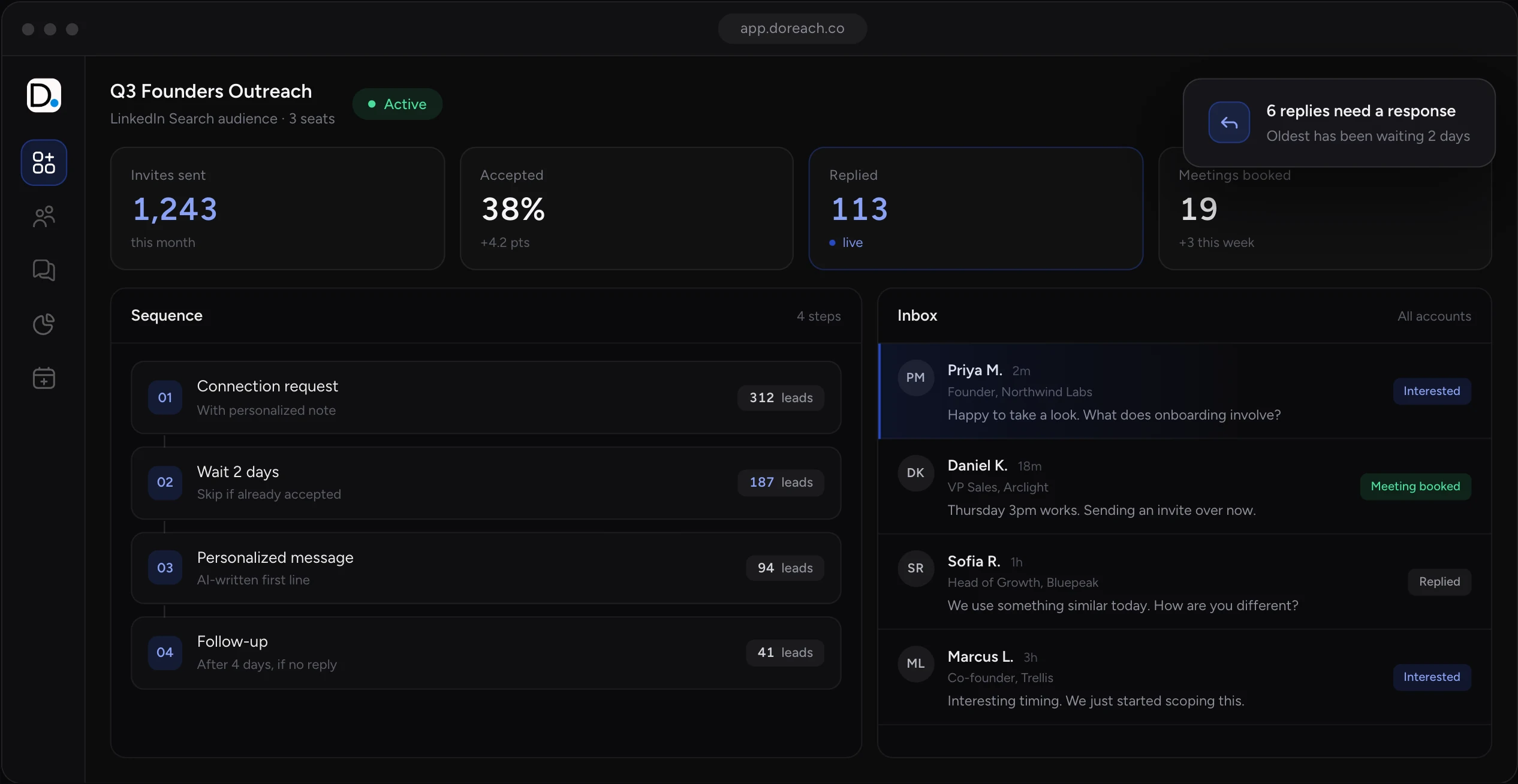
The shape that works
| Step | Timing | Job |
|---|---|---|
| Connection request | Day 0 | Get permission |
| First message | 1 day after acceptance | One reason, one question |
| Follow-up | 4 to 5 days later | One new thing |
| Close | 7 days later | Easy to decline |
Three to four touches over about two weeks. Longer sequences rarely produce more replies and reliably produce more reports. LinkedIn says member reports, combined with its automated defenses, help it find abuse, and repeated spam can lead to an account restriction.
Wait a day after acceptance
A message that lands seconds after someone accepts your request is obviously automated. Nobody is that fast, and everyone knows it.
A day is enough. In Doreach that is a delay on the step rather than something you have to remember.
Every follow-up carries something new
“Just bumping this to the top of your inbox” tells the reader you have nothing to add and would like their attention anyway.
Useful follow-ups do one of these:
- Approach the same problem from a different angle
- Offer a specific example from a company they would recognise
- Ask an easier question than the first one did
- Name the likely objection and address it directly
If you cannot do any of those, the follow-up is not ready.
Make the last one easy to say no to
The final message should give the reader permission to decline. Something like “if this is not relevant, no problem at all, happy to leave it there.”
Two things happen. You get more honest answers, which is genuinely useful information. And you protect the account, because people who can decline gracefully do not report you.
Replies stop the sequence automatically
This is worth being explicit about because it is the failure mode people fear most.
In Doreach, the moment someone replies, their remaining steps are cancelled. Nobody gets a scripted follow-up to a conversation they already started. It is on by default, so you do not have to build the rule. Everything lands in the unified inbox where you pick it up.
What to do next
Open your current campaign and count the steps. If there is one message and nothing after it, add a single follow-up at five days carrying one new idea, and a close at day twelve that makes it easy to say no.
That one change usually moves reply rate more than any rewrite of the opener.