Search for LinkedIn automation tools and you get a dozen ranked lists, and in almost every one the author’s own product is number one. Salesforge ranks Salesforge first. SalesRobot ranks SalesRobot first. LeadHaste, Botdog and Fuzzy all do the same.
We build one of these tools, so we could have done the same. Instead this compares eleven tools on two things you can check for yourself: what they charge, and whether they tell you how many messages they will send from your LinkedIn account.
Only five of the eleven answer the second one.
How we compared these
Worth being explicit, because the method is most of the value here.
The price you can sign up for yourself. Every figure came from the vendor’s own pricing page on 14 September 2026. Several of these tools also sell larger plans aimed at agencies. Some publish a price for those, others ask you to get in touch. Either way they are not in the table, because they are built so differently that lining them up against each other would tell you nothing.
Whether they tell you the sending limits. Some tools say publicly how many connection requests and messages they will send from one LinkedIn account, and over what period. Others say nothing. We have recorded which is which. “Not published” means the numbers are not on their website. It is not a claim that the tool is unsafe, and we have no evidence that any tool here is.
No ranking from one to eleven. These tools are not chasing the same buyer. A Chrome extension for one person and a cloud platform for an agency with twenty client accounts are different products, so putting them in order would be meaningless. They are grouped by what they are instead.
Everything here comes from what the vendors publish. Prices from pricing pages, limits from documentation, features from each vendor’s own description of them, all stamped with the date we checked so you can see when this page has gone stale. Doreach is ours, so we know it from the inside, and you should weigh that accordingly.
The comparison
| Tool | What it is | Entry price | Billed per | Publishes limits |
|---|---|---|---|---|
| Doreach | Cloud, multi-account | $36/mo annual | LinkedIn account | Yes, all four |
| HeyReach | Cloud, multi-account | From $47/mo annual at 10+ senders | LinkedIn account | No |
| Expandi | Cloud, multi-account | $79/mo annual | Account | No |
| Dripify | Cloud | $59/user/mo annual | Human user | Yes |
| lemlist | Cloud, email-first | $87/user/mo annual | User, 5 senders | Partly |
| La Growth Machine | Cloud, multi-channel | €60/identity annual | Identity | No |
| Waalaxy | Cloud | €49/user/mo annual | Human user | Yes |
| Meet Alfred | Cloud | $35/user/mo annual | Human user | No |
| PhantomBuster | Cloud automation and scraping | $56/mo annual | Plan, metered in slots and runtime | As guidance |
| Linked Helper | Desktop app | From $8.25/mo | One licence, one account | Yes |
| Octopus CRM | Chrome extension | From $6.99/mo annual | Account | No |
Cloud platforms built for many accounts
The category most agencies and sales teams are actually shopping in.
HeyReach
The most established of the multi-account tools. It was designed around running many accounts rather than adapted to it later, so workspaces and permissions match how an agency actually works. Team members, VAs and clients are free.
It has the longest integration list here: Clay, HubSpot, Make, Zapier, RB2B, Trigify, an API, webhooks, and an MCP server that almost nobody else has shipped.
Choose it if your stack runs through Clay or n8n, or you need whitelabel. The catch: $63 per account against Doreach’s $36, and no published limits anywhere.
Expandi
The only tool here offering a dedicated country-based IP per account and profile auto warm-up. That is the closest thing to a genuine safety-features argument in this category, and neither we nor HeyReach match it.
Choose it if dedicated IPs and warm-up matter to you. The catch: the most expensive self-serve entry at $79, and limits are configurable rather than published.
Doreach
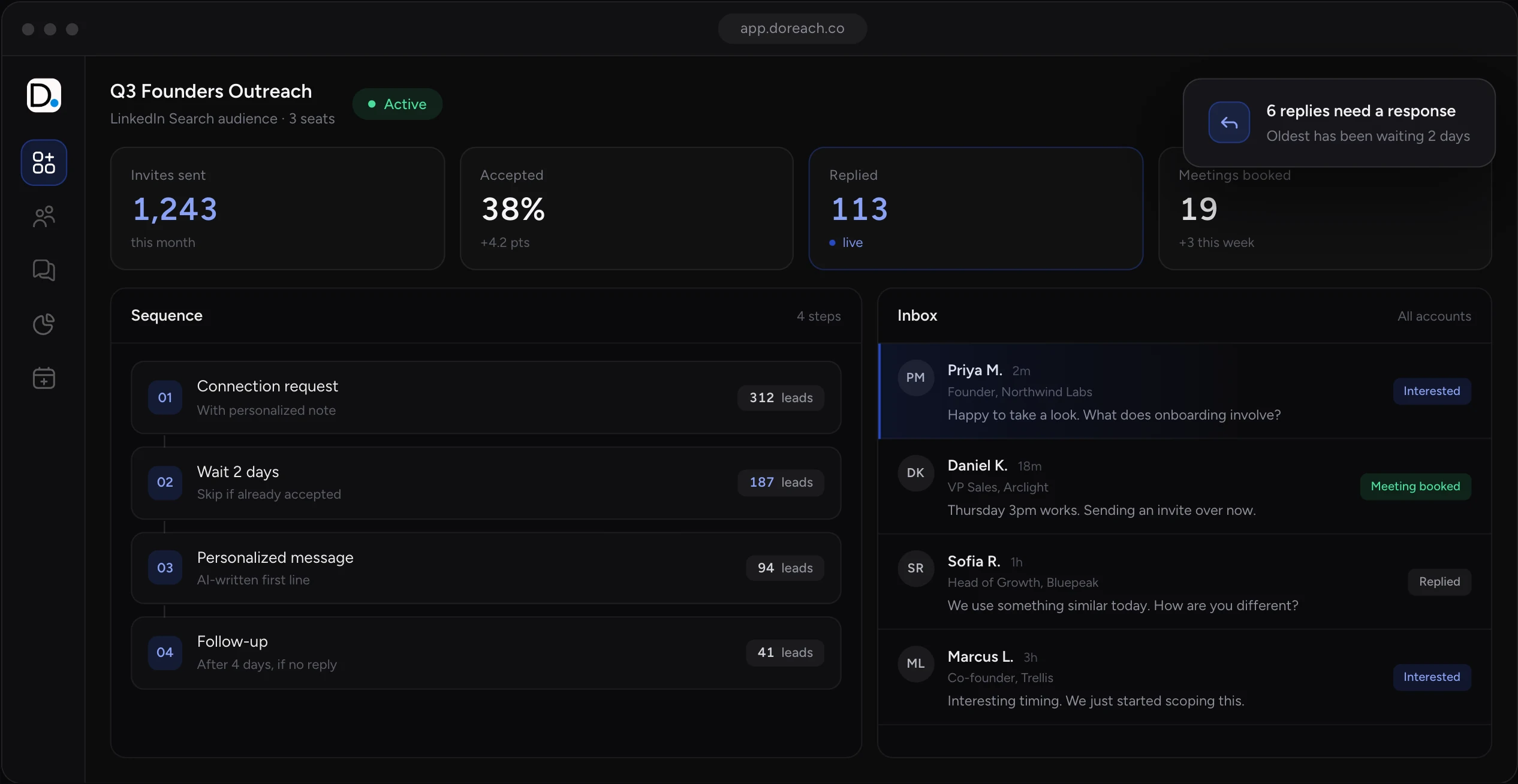
Ours. The cheapest cloud multi-account option at $36 per LinkedIn account on annual billing, with unlimited free team members, and the only tool in this set that publishes all four of its per-account weekly limits: 80 connection requests, 100 messages, 150 profile views and 25 InMails. Doreach also includes one connected mailbox, supports email steps, and gives every plan access to its MCP server.
There is also only one plan, and everyone gets all of it. A solo founder on one account has the same audience sources, the same sequence builder, the same shared inbox and the same team features as an agency running twenty. Most of the tools above put those behind a higher tier.
Choose it if per-account cost matters, you would rather have one plan than a tier decision, or you want to read the limits before connecting anything. The catch: far fewer integrations than HeyReach, no whitelabel, and no email finder. Extra mailboxes cost more, while the base subscription includes one.
La Growth Machine
Genuinely multi-channel: LinkedIn, email, X and calls in one sequence with branching logic. Billed per identity, with team members included by tier.
Choose it if you want several channels in one workflow rather than stitched together. The catch: €60 per identity on Basic caps you at three identities, and the €120 Pro tier is the most expensive per-seat option here.
Cloud platforms built for one person or one team
Dripify
Simple, quick to launch, and it does publish its limits, which most of the category does not. Worth reading those numbers carefully though: 75 connection requests per day on Pro. That is roughly 375 a week, well above what most established accounts tolerate. A published ceiling is a description of capability, not a recommendation.
Choose it if you want the shortest path to a working drip campaign. The catch: billed per human user, which breaks down for agencies managing clients’ profiles.
Waalaxy
An easy on-ramp for one person. A 14-day free trial on every plan, a visual sequence builder, and published quotas: 300 invitations a month on Pro, 800 on Advanced and Business. Plans are €19, €49 and €69 per user a month, with 50% off on annual billing.
Choose it if you are one person starting out and want to try before paying. The catch: per-user billing and not built for running many accounts.
lemlist
Email-first, with LinkedIn as one channel in a sequence. Five senders included per user.
Choose it if email is your main channel and LinkedIn is a supporting step. The catch: at $87 per user it is the priciest entry here, and if LinkedIn is your primary channel you are paying for infrastructure you will not use.
Meet Alfred
Multichannel across LinkedIn, X and email, with team inbox management and whitelabel on the Team tier.
The catch: billed per human user, at $35 a month on annual billing or $59 month to month on the entry plan, which Meet Alfred now calls Individual, and no published limits.
PhantomBuster
A cloud automation and scraping platform where LinkedIn is one of many targets. It does run outreach: its LinkedIn automations send connection requests and messages, and its ready-made workflows chain a request with follow-ups. Plans start at $56 a month on annual billing and are metered in automation slots and execution hours, not in messages sent. Its support centre publishes LinkedIn rate limits as guidance you apply to each automation, not as a ceiling the tool enforces.
Choose it if you want data from several platforms and are comfortable governing your own sending limits. Not for you if you want campaigns, an inbox and reporting out of the box.
Desktop apps and browser extensions
Cheaper than everything above, and a different product rather than a discount version. Both run on your own machine, one licence to one LinkedIn account, and both stop when the machine does.
Linked Helper
A desktop app, from $8.25 a month on a twelve-month term with local storage, or $16.50 with cloud storage. Publishes its limits: on Standard, connection requests and message sequences are uncapped, while eleven advanced actions, including group and event messages, engagement, webhook and CRM actions, are capped at 20 a day. Pro advertises unlimited daily actions. That “unlimited” is a plan feature, not a safety recommendation.
Choose it if you are a solo operator happy to leave a computer running.
Octopus CRM
A Chrome extension, from $6.99 a month on annual billing or $9.99 month to month, with a 7-day free trial. The cheapest way to try LinkedIn automation at all.
Choose it if you want to find out whether any of this works for you before spending real money.
What LinkedIn actually says about automation
Worth stating plainly, because most comparison posts skip it or imply their tool is exempt.
LinkedIn’s user agreement prohibits automated access. That applies to every tool in this list, including ours. No vendor here is officially sanctioned, and anyone telling you their product is approved by LinkedIn is selling you something.
LinkedIn also does not publish one universal number for standard invitations. Its invitation restriction guidance says it may restrict an account for sending many invitations in a short time, having many invitations ignored, pending or marked as spam, or suspected use of automation.
Those conditions do not become safe because a tool allows a higher setting. Target people who have a reason to accept, keep volume controlled, and stop if LinkedIn shows a warning. No setting or vendor can guarantee that an account will avoid a restriction.
That is why we think publishing limits matters. Not because a published number makes a tool safe, but because you cannot evaluate a tool’s pacing before buying if it will not tell you what the pacing is.
Picking one
The short version, by situation:
- Agency, many client accounts, deep integration stack: HeyReach.
- Agency or team, cost-sensitive, wants published limits: Doreach.
- Dedicated IPs and warm-up matter most: Expandi.
- Several channels in one sequence: La Growth Machine, or lemlist if email leads.
- One person starting out, wants a free trial and a simple builder: Waalaxy.
- One person, cheapest credible, happy on desktop: Linked Helper.
- Just want to see if this works at all: Octopus CRM.
- Data extraction rather than campaigns: PhantomBuster.
Whichever you pick, the thing that decides your results is the list, not the tool. Every platform here will send a badly targeted campaign to two thousand people very efficiently.
Prices and published limits were checked against each vendor’s own pricing page on 14 September 2026, and this page carries the date it was checked so you can tell when it goes stale. Our own figures and limits are on the pricing page and in limits and pacing. The full side-by-side table lives on our comparison page.