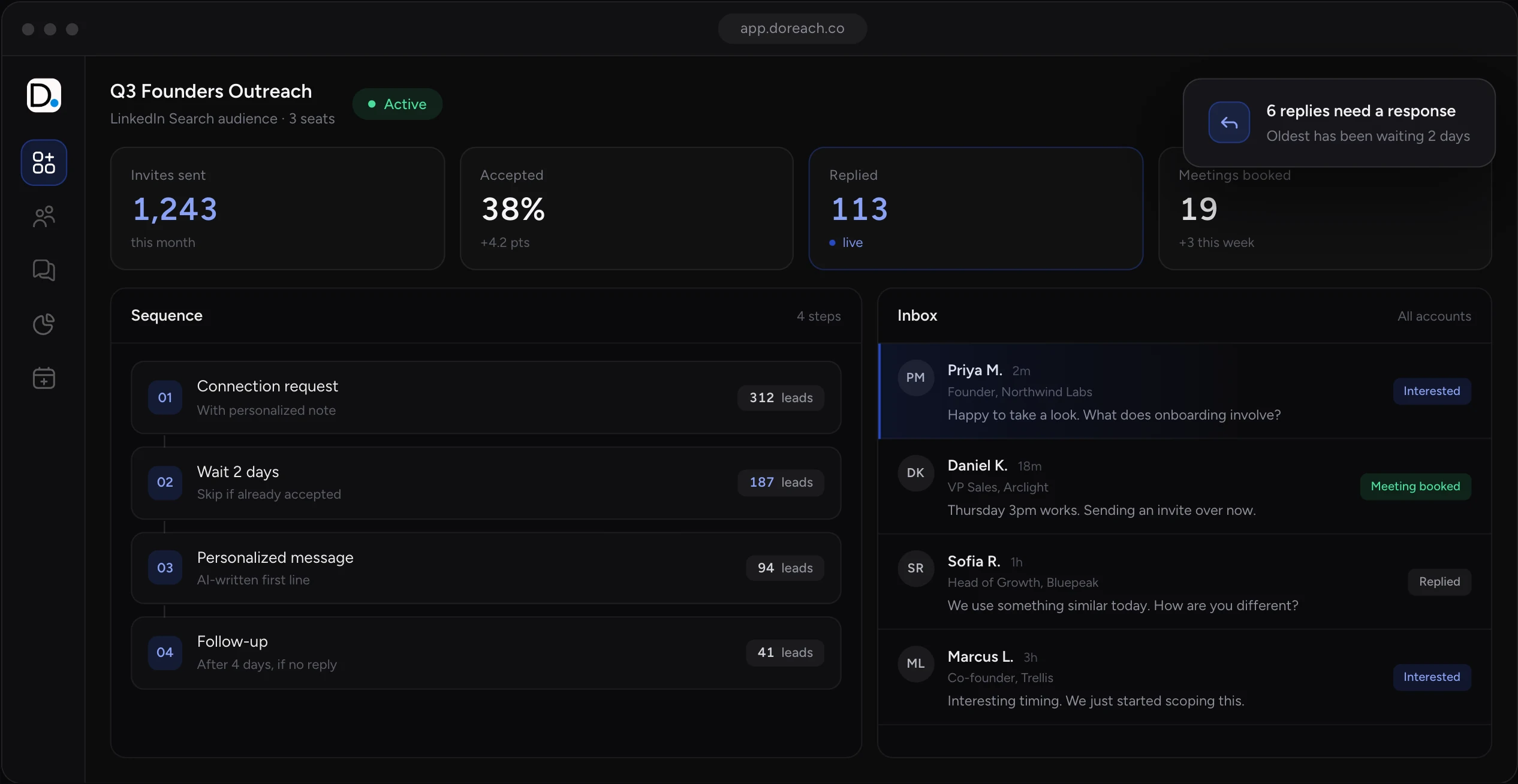
You send fifty connection requests, twelve get accepted, and you assume the message is wrong.
Sometimes it is. More often the message never had a chance, because the fifty people had no visible reason to accept. So before rewriting anything, look at your acceptance rate. Under 20% and the list is the problem. Above 30% and the words are worth tuning.
Here is what works, with the reasoning, and then examples you can adapt.
The 200-character reality, and the limit almost nobody mentions
LinkedIn caps connection request notes at 200 characters. That is roughly two short sentences, and it is the entire budget.
Write to about 180. Merge tags expand at send time, so a note that fits while you are typing can overflow once a real first name and a long headline get substituted. Doreach warns you as a note approaches the cap for exactly this reason.
If you have read other guides on this and come away thinking you have 300 characters, they are quoting an older LinkedIn page. LinkedIn’s page comparing InMail and personalized invitations still gives Premium members 300, but it was last updated two years ago. The page on personalizing invitations, updated in 2026, says each message can be up to 200 characters. Go by the newer page and write to 200.
The second limit matters more and is almost never mentioned. A free LinkedIn account can attach a note to only three connection requests per month. That is the figure on LinkedIn’s page on personalizing invitations, checked on 16 October 2026. Its page on invitation limits still says five, but that page was last updated a year earlier. Plan for three. Premium members can personalize every invitation. So the honest version of the advice is:
| Account | Personalized invites per month | Note length |
|---|---|---|
| Basic (free) | 3 | 200 characters |
| Premium or Sales Navigator | Unlimited | 200 characters |
That table decides more outreach programmes than any wording choice. If you are on a free account and planning to personalize a hundred requests a week, you are planning something LinkedIn will not let you do. Either budget for Premium or run the campaign without notes, which is worth testing anyway.
Consider sending nothing
The most useful test most people never run: send half your requests with no note at all.
A bare request asks for one thing. A request with a pitch attached asks for two, and gives the recipient a reason to decline before they have any reason to accept. Plenty of people accept an empty request out of simple curiosity, then read your first message with more patience than they would have given a cold pitch.
Run it as a real comparison over a hundred people per version before deciding.
What a good note actually does
It gives one specific reason you are connecting with this person and not somebody else.
That is the whole standard, and it is testable. Read your note and ask whether it could be pasted into a request to a different person unchanged. If it could, it is a greeting, not a reason.
Examples
Shared group
Saw you in the RevOps Co-op group. Been following the thread on outbound attribution and wanted to connect with people actually solving it.
They posted something
Your post on killing the cold call quota stuck with me, mostly because we tried the same thing and it went badly at first. Would like to connect.
Same event
We were both at SaaStock last month. Connecting with the people I did not get to speak to.
Mutual connection
Priya suggested I connect with you after we talked about outbound hiring. Happy to be a useful contact either way.
Genuinely cold, but specific
You are one of the few people running outbound for a services business rather than SaaS. That is the version I understand least well and want to learn about.
No note
(nothing)
Notice that none of them mention a product, ask for time, or explain who you are. That comes later, once the connection exists.
Templates are a starting shape, not a script
The examples above are patterns, and patterns are worth having. What makes them fail is being sent as written.
A template earns its place when it fixes the structure and leaves the specific detail to you: the group, the post, the event, the mutual contact. It stops earning its place the moment the specific detail is also templated, because that is the thing the recipient is checking for.
The practical test before you save anything as a reusable outreach template: delete the one detail that makes it about this person. If the message still makes sense, it was never personalized, and no amount of variation will fix that.
The message after acceptance is the one that matters
Almost everyone writes the connection note carefully and then improvises the first real message. That is backwards. The note buys you a connection. The message after it is where a reply is won or lost, and it has no 200-character cap, which changes the failure mode: the note fails by being generic, the follow-up fails by being long.
Three things it should do, in order:
- Continue the reason you gave. If you connected over a post they wrote, the first message picks that thread up. Starting a new topic tells them the note was a pretext.
- Ask one question they can answer in a line. “How are you handling X now” gets answered. “Would you be open to a quick call to explore how we might help” does not.
- Say nothing about your product yet. You are one message into a relationship that started with a stranger accepting a request.
A worked pair, so the join is visible:
Note: Your post on killing the cold call quota stuck with me, mostly because we tried the same thing and it went badly at first. Would like to connect.
First message, two days later: Thanks for connecting. The part of your post I keep coming back to is the reps who quietly kept dialling anyway. Did you end up letting them, or did you hold the line?
Nothing is being sold. The question is answerable in one sentence, and answering it starts a conversation in which a product can eventually be mentioned honestly.
Wait a day or two before sending it. A message that lands the same second the request is accepted reads as automation, because it is.
What to avoid
- “I would love to connect and explore synergies.”
- Anything that opens with your job title.
- A compliment about their profile that could apply to anyone.
- A meeting request. You have not earned it in 200 characters.
Writing these in Doreach
Two things make this practical at volume.
Spintax varies the wording. Write {Saw you in|Noticed you are in} the {{headline|your}} space and Doreach picks one option per send. Three ways to open and two ways to close is six versions from one note, which is the difference between a pattern and a person. More in merge tags and spintax.
Fallbacks stop the embarrassing failure. Write {{first_name|there}}, never {{first_name}}. An empty tag renders as nothing, which is how “Hi ,” gets sent to two hundred people. Doreach blocks a launch on an unclosed or unsupported tag, and warns on note length before you send rather than after.
The audience still does most of the work. Post engagers and event attendees hand you a real first line for free; a title filter does not.
What to do next
Take your current connection request and split it into two versions: your existing note, and no note at all. Send each to a hundred people from the same list. Compare acceptance rate, not replies.
If both come back under 20%, stop testing copy and go rebuild the audience. That is the fix.